If you're going to build your own version of something, it helps to know what the original actually does. Not from the marketing page. From using it.
So the first day of Asset Forge was mostly research. The first commit in the repository is a set of rules for exploring Sorceress while logged in. Code came later that afternoon.
Everything public, for free
Three research cards ran in parallel on 2 October, all logged out, with no purchases:
- One captured 122 Sorceress pages (113 loaded, 8 were behind the login, 1 was a deliberate 404 test) and the public API catalogue, which listed 57 live tools.
- One went through every Sorceress tutorial and demo video. It found 579 uploads and kept 189 relevant ones with transcripts. 138 were duplicates: re-uploads or excerpts.
- One collected community posts, reviews, the Wayback Machine history and a comparison with other tools.
A fourth card turned all of that into a feature catalogue of 60 entries. It mapped the 75 models Sorceress uses to what I could reach: 54 exact matches, 6 from the same family, 8 substitutes and 7 with no equivalent.
That last number was the one I cared about. Almost everything Sorceress runs, I could run too.
Inside, on the free trial, without spending
New Sorceress accounts get 100 free credits. Six exploration cards mapped the logged-in tools screen by screen, and the credit counter read 100 at the start and end of every one of them.
That wasn't luck. The browser was set up to block any request that could spend credits or change something on the account. It was tested once for real: a stray click hit the Generate button in one of the parallax tools, and the safety net stopped the credit check before anything was sent.
Small paid tests
Then I let it spend, a little. One card ran a single Auto-Sprite V3 character for 29 credits. The next tested the other generators for 56. The trial's 100 credits went down to 15.
After that I set up Sorceress Pro and bought 1,000 credits to test with. The first payment for Pro didn't go through, so the account check stopped and waited until it was sorted. Once Pro was active, the starting balance was 1,015 credits.
That card spent nothing. It wrote a test plan: four capped cards, 700 credits approved, about 315 held back. Every test card had a hard credit cap and a floor it was not allowed to go below.
The Pro tests spent 26, 121, 177, 208 and 147 credits across five cards. That's 679. An optional sweep at the end spent 282 more, on things like Meshy 7 and Tripo 3D models, a 1080p Kling walk and splitting the vocals out of a song.
In total, the research used 1,046 Sorceress credits. At Sorceress's own price of 1 credit = $0.01, that's about $10.46 of credits at face value. That isn't what I paid for the account, which I'm leaving out here.
Every image the tests needed came from Higgsfield's Unlimited Nano Banana Pro, so the research cost nothing there.
What I learned
The research summary opens with this:
Sorceress is a wide toolbox. Most of the clever work is in its prompts and glue code, not in its models.
That shaped everything after it. The models are the same ones I can reach through fal, Higgsfield and ElevenLabs, usually for less. So the job was to copy the good recipes, fix the weak spots, and skip the tools that didn't earn their place.
The tests covered 97 items across 53 tools and routes. By the end, 47 had been tested for real, 3 were broken on Sorceress's side, 29 were mapped from the screen only, 3 were never touched, and 15 were off-limits (VIP features, admin, publishing, purchases, API keys, voice cloning).
Where Sorceress was better
I want to be fair here, because several of its ideas went straight into Asset Forge.
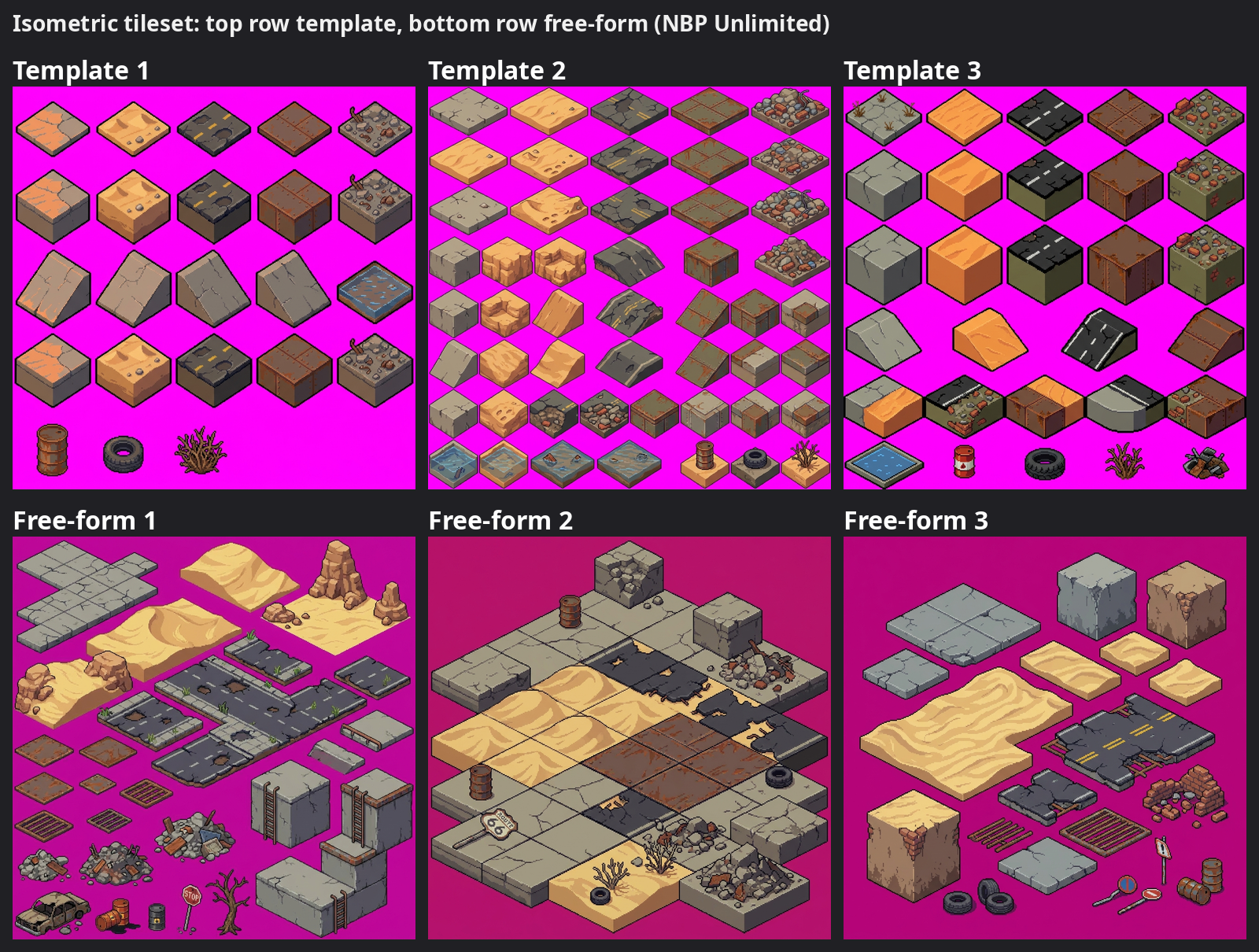
Prompt templates. Its isometric tile template spells out the cell size, the 2:1 diamond shape, a list of tile types, the light direction and a plain backdrop. It scored 9/10 against 5/10 for a free-form prompt on GPT Image 2. I built the same idea as v1.5.2 and tested it on the free Unlimited model. The template won clearly for isometric sheets (8.0 against 4.3 on average). For side-scroller terrain and props, the free-form prompt did a bit better. The cover image is that test.
A free cutscene planner. Its storyboard agent fills in every shot's camera, action, sound and narration for nothing. A Flux 2 Pro frame cost 6 credits and kept the pixel-art look.
Error messages you can act on. Kling's motion match on Sorceress passes the vendor's reason through: "No complete upper body detected". Through Higgsfield I only ever saw "failed". Filming the guide video from three-quarters in front fixed it, and the walk came out at 7/10.
Music stems. It splits a track into 12 stems for 42 credits. Seven had real sound in them; five were nearly silent on a chiptune loop.
Where Asset Forge was already as good or better
Price. The Hunyuan 3D model is 30 credits there (about $0.30) and $0.225 on fal. A three-shot cutscene was about $0.15 to $0.30 on fal's Wan against 150 credits there.
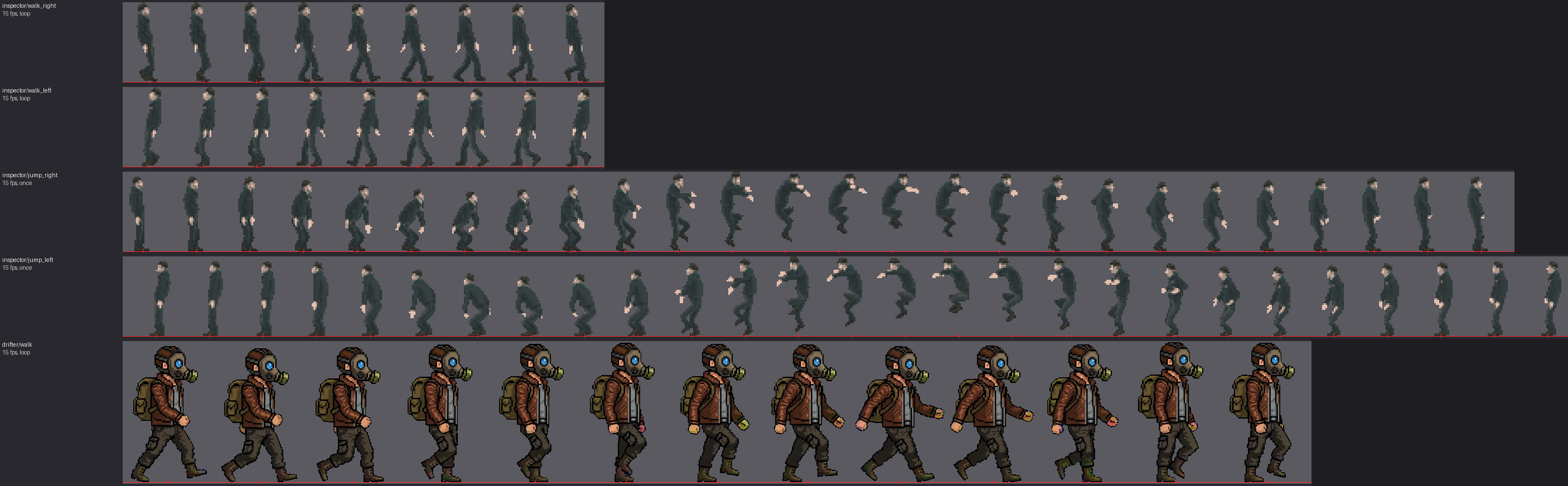
Sprite clean-up. My Auto-Sprite pipeline turned the Kling and Wan 2.7 walks into 64 px loops that join up cleanly, 18 and 11 frames, with the drifter's blue lens kept, no magenta fringe and the feet on one row.
Reliability. Several Sorceress features never worked in these tests. Movie Maker's export failed three times because a tool was missing on their server. Talking Avatars hit an outage five times out of five (all refunded). The 3D Studio's Texture tab captured a black frame. The Image Expander failed on files above about 4 to 5 MB.
No VIP walls. Both Sorceress parallax tools needed VIP even on Pro.
What I built from the list
The summary ended with a ranked list of what to build next. Most of it shipped within days.
- Picture to 3D model to rig, with an automatic shrink step: v1.5.0.
- The motion-guide fix (film the driver from three-quarters in front): shipped in the experimental motion guide.
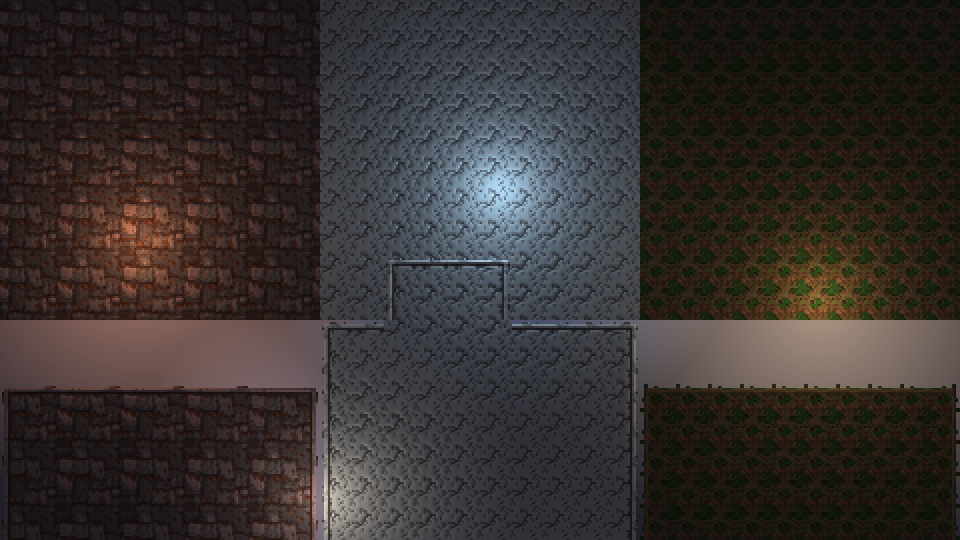
- Tiles with 2D normal maps, so lights in Godot shade them: v1.5.1.
- Prompt templates for tiles: v1.5.2.
- A cutscene card with a local video export: v1.13.0.
- One export format for every sprite sheet: v1.5.3.
- Layered game music: v1.10.0.
- A talking NPC: v1.11.0.
- 3D-to-2D polish: v1.5.3 and v1.19.0.
The summary also had a "not worth building" list. Quick Sprites as its own tool was on it, because Sorceress runs it on Replicate, which isn't one of my routes. I built it anyway as v1.20.0, on Nano Banana Pro plus my own pixel pass, which is what the summary suggested doing instead.
I skipped the rest of that list: the Texture tab (broken there), a full voxel editor (MagicaVoxel is free, and my own Voxel Studio cards are on hold), Sorceress's VIP parallax, and Talking Avatars as a separate page.
What went wrong
An API key ended up in git history. While the exploration cards were logged in, Sorceress created an API key on the account, and its full value got committed twice. A cleanup card rewrote the repository's history with git-filter-repo. The key turned up 133 times across 7 commits. The same card added a pre-commit check for secrets (15 of 15 tests pass) and told me to delete the key on Sorceress itself. It's the most avoidable mistake in the whole project.
A spend nobody asked for. Once Pro was on, Auto-Sprite V2 switched to a paid cloud keyer by default and charged 1 credit nobody had planned.
Runs kept running out of steps. Every Pro test card needed two or three runs. Every time, the run had hit the agent's own step limit, not the credit cap. Post 4 gets into why.
Kling turned down the jump three times. Its motion match wants at least 3 seconds of continuous movement, and a single jump is about 2.4. All three were refunded.